
Spectral Message
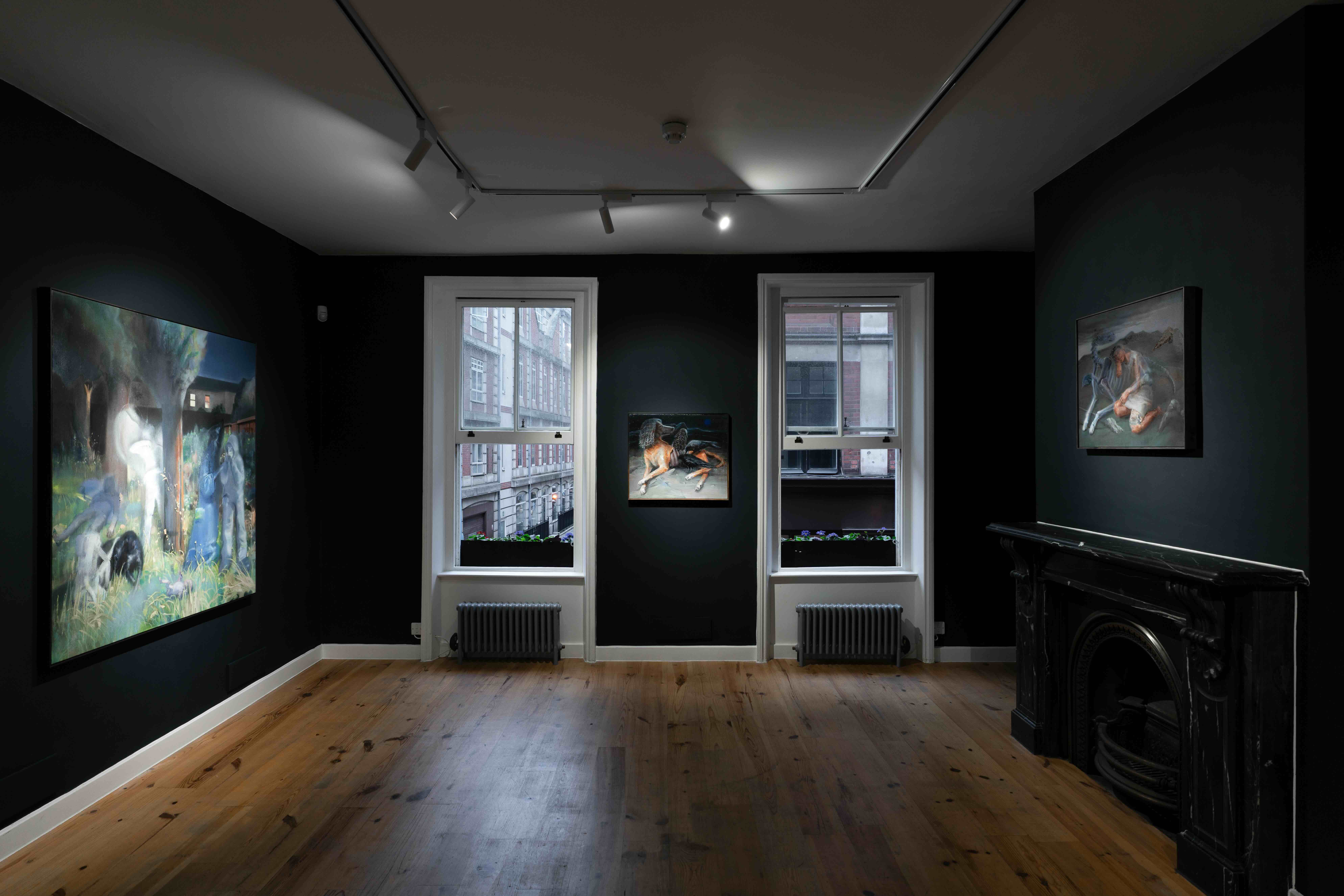
Spectral Message brings together the paintings of Soryun Ahn and Lulu Stephenson in a dialogue centred on deferred narrative – a meaning that is constantly arriving, never fully grasped. Within a gallery painted dark navy, their works appear as scattered apparitions. Both artists approach painting as a time-based medium investigating the boundary between real and imagined worlds, yet through divergent methods. Ahn constructs carefully staged, figurative, theatrical imagery where mundane and mythological elements collide, while Stephenson pursues the physical traces of movement through her tools, excavating forms from the material itself to produce more abstract scenes. Their works share a language of light and illegibility, where stories suggest themselves but resist closure.
Soryun Ahn’s paintings depict psychologically charged mythic scenes caught between familiarity and mystery, capturing moments that suggest significance while withholding explanation. Their theatrical quality results from a methodical process where Ahn photographs, prints and redraws each evolutionary stage before applying paint to canvas. In works like Nocturnal Apparition (2025), an ordinary British streetscape appears under artificial blue light, as if illuminated by a camera flash. Within this manufactured glow, indistinct figures materialise: a tracksuited figure, a winged entity, a child caressing an animal, a baby lying in the grass. The presences occupy the same space without clear narrative connection, and their averted gazes enhance the sense that the viewer is glimpsing isolated beings suspended across multiple mythologies or dimensions.
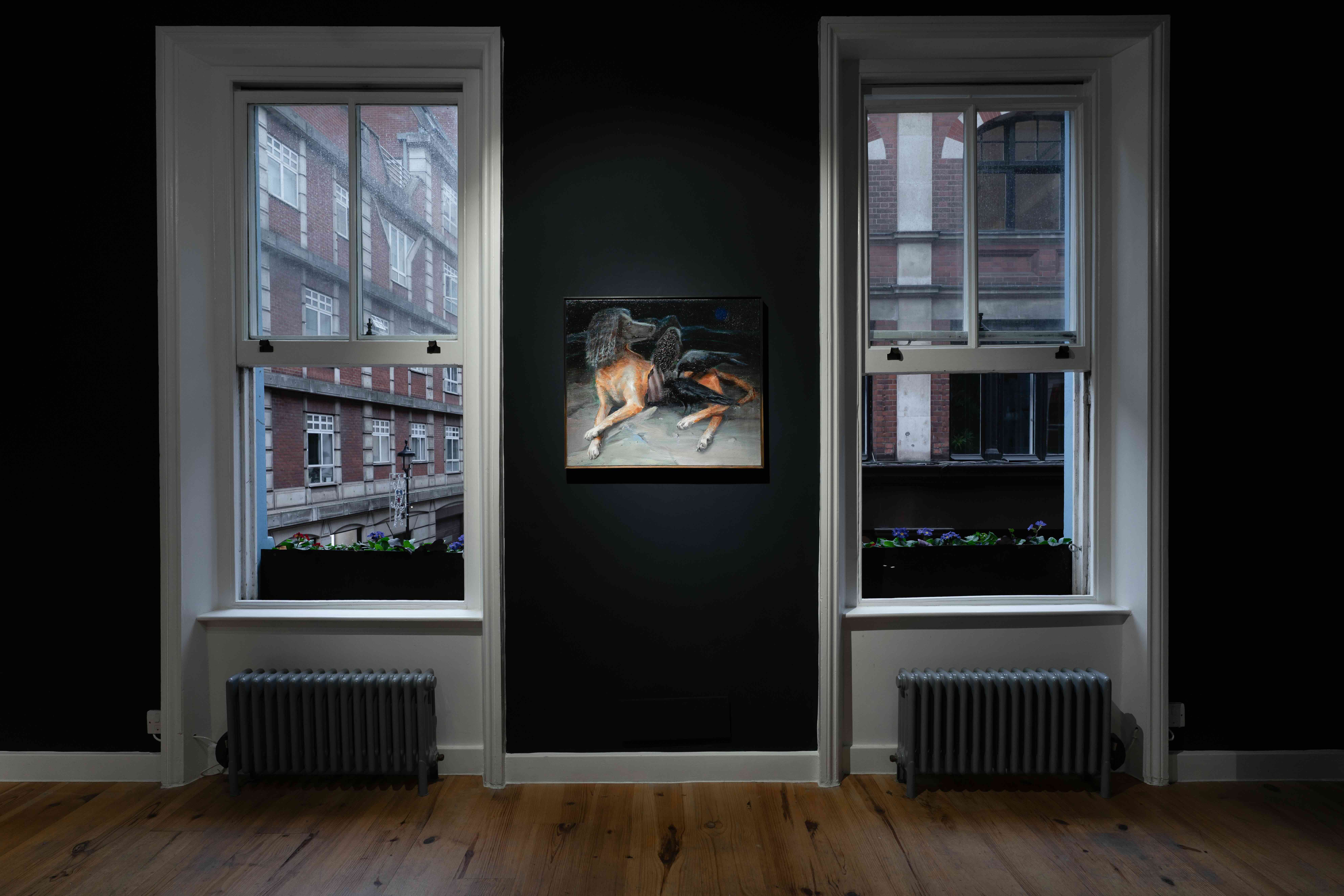
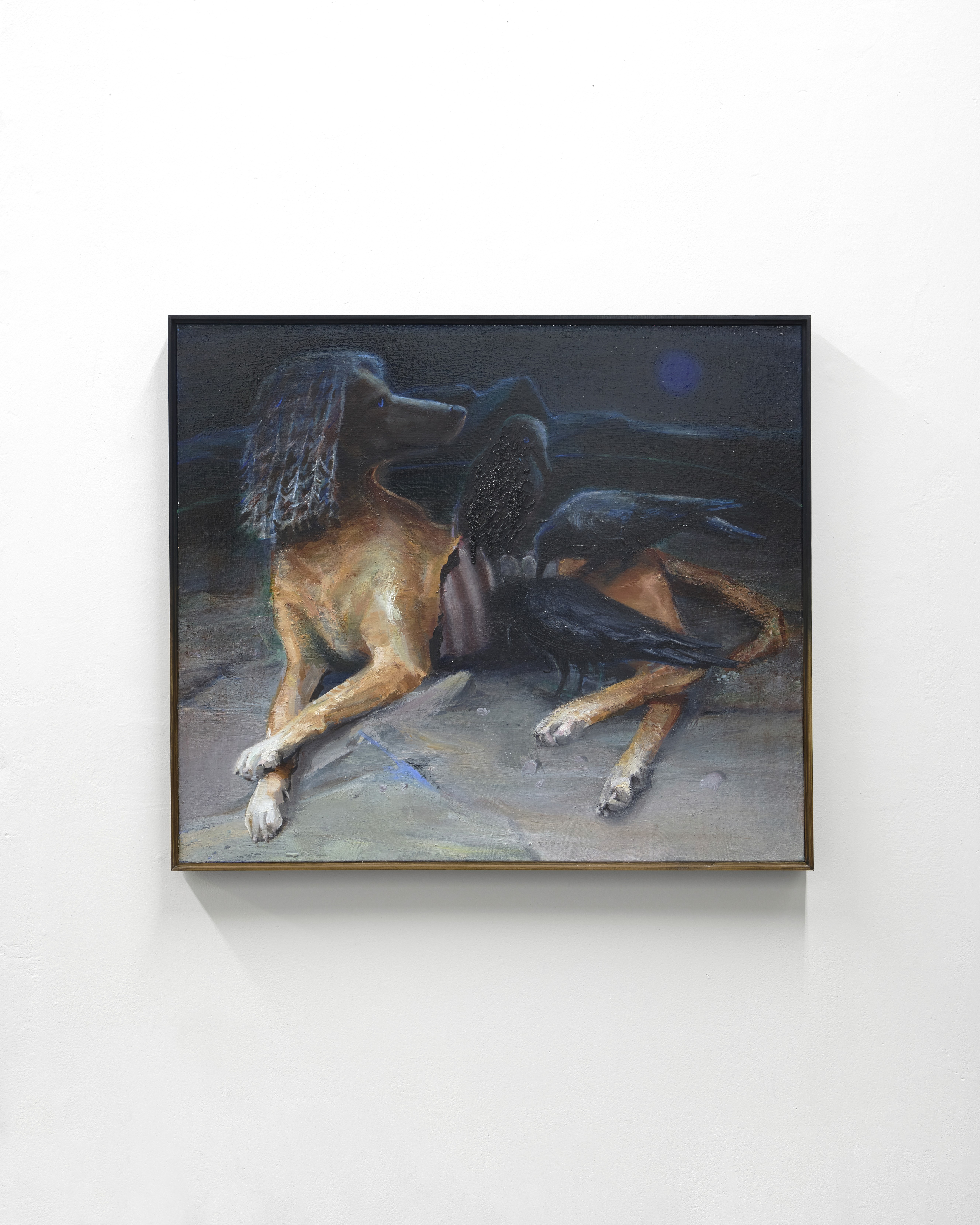
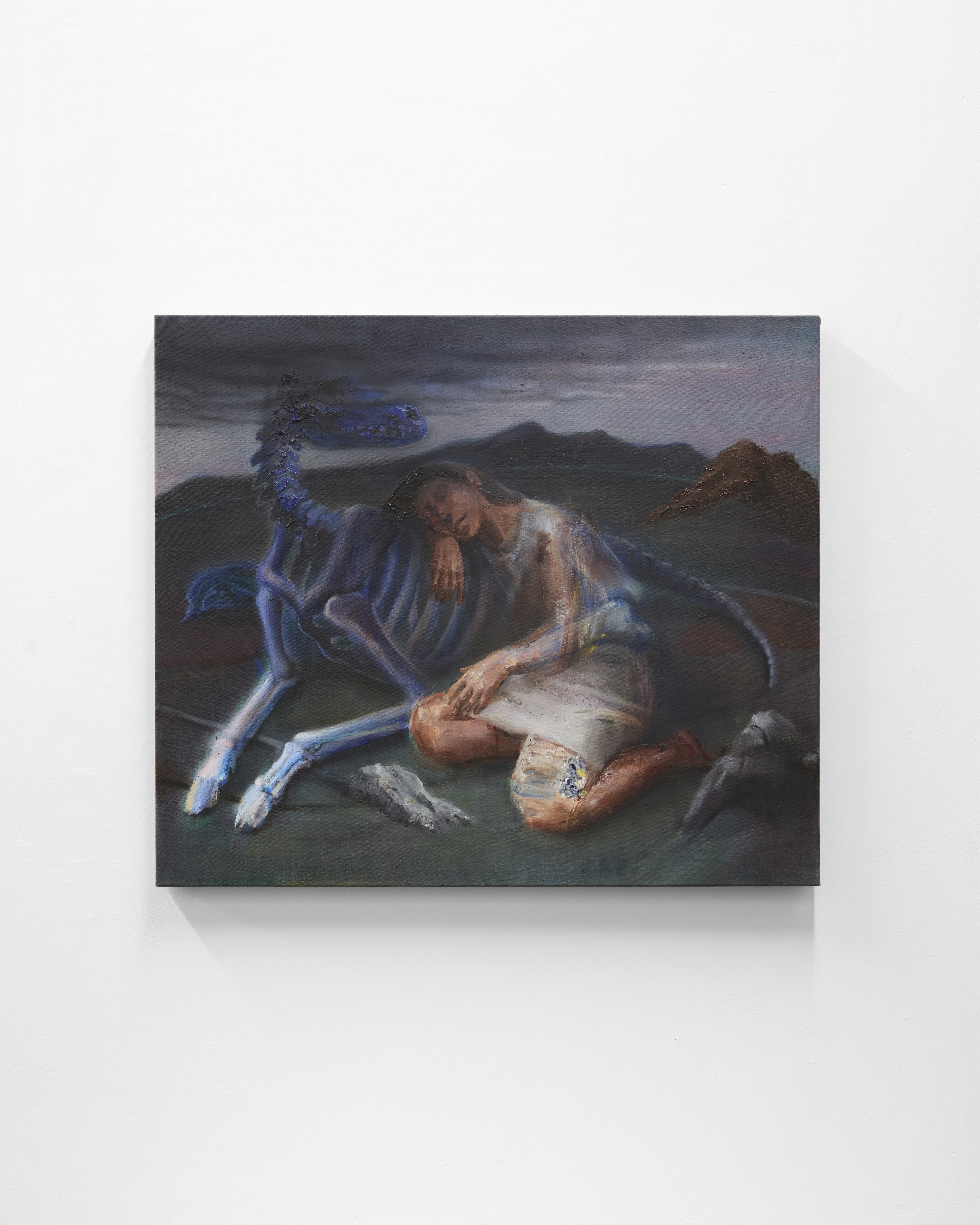
This exploration of hybrid states extends to her other two paintings, Between the Dawns I and Between the Dawns III (2025). Both stage encounters between bodies that don’t entirely cohere. In Between the Dawns I, a dog lies composed but not quite relaxed at night, its torso interrupted by three black birds – a seam where feathers and fur overlap without resolving into a single, stable image. Between the Dawns III follows this logic of shared edges: a figure leans into the cool, luminous skeleton of an animal, their body softening into the gaps between its ribs and limbs. Across both works, the emphasis is on the space where bodies meet, offering moments of contact suspended just long enough to be seen before they slip back into ambiguity. The creatures embody what the artist describes as a ‘double feeling’ – existing in a paradoxical state between life and death, fear and embrace. These smaller paintings function as parallel emanations rather than sequential scenes, operating as afterimages that cling to reality's residue while invoking its absence.
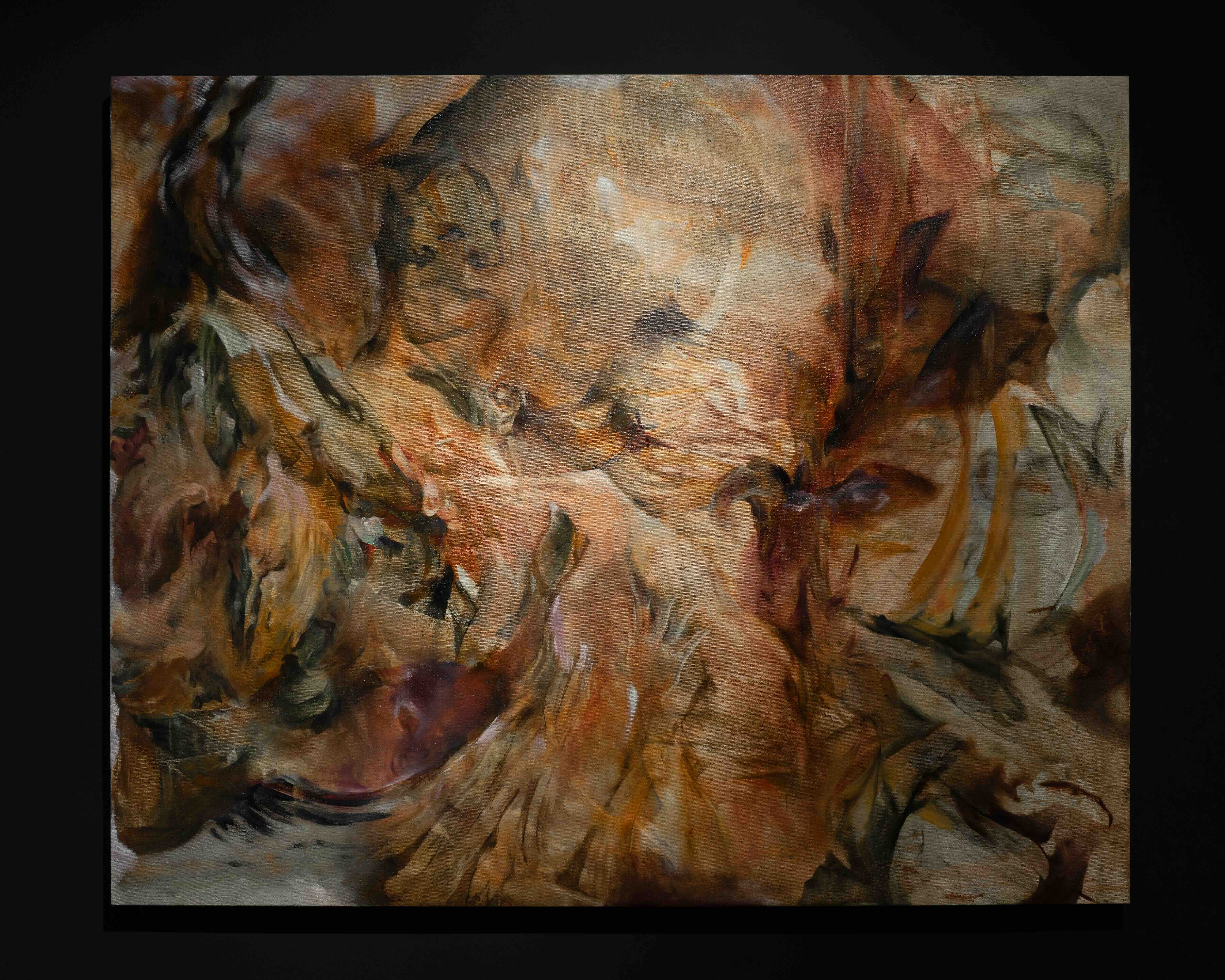
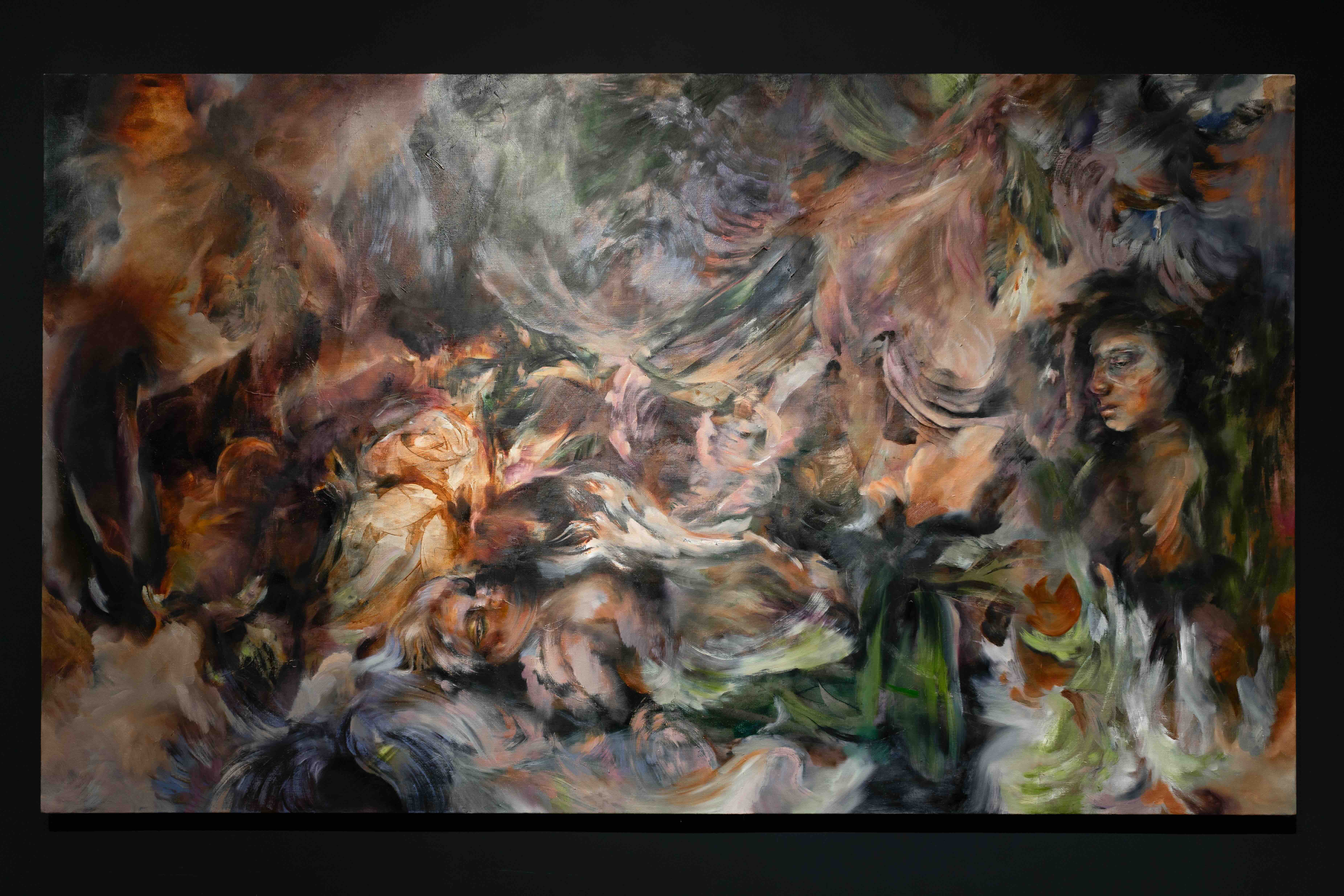
Lulu Stephenson treats memory as tangible matter to be excavated rather than stories to be told. Her process involves the constant addition and subtraction that mirrors memory's unreliable nature. She applies layers of fluid paint to canvases laid flat, allowing pigments to settle without gravitational direction, then scrapes, carves and washes them away using unconventional tools such as sponges and cold wax scrapers. The resulting surfaces balance harsh lines against ethereal washes, appearing weathered and fractured. From these excavated grounds, semi-formed figures materialise – an eye, an ear, kissing faces – inhabiting psychological landscapes of fleeting sensation. ‘I think of memory as a raw material’, Stephenson explains. ‘It sits in my studio as an almost-object, next to my paints, my palette. It has a weightiness to it, a physicality [...] Paint exists in something of a parallel space, constructing reality while also confusing it.’ Stephenson’s current investigation of non-finito sculptures – particularly Michelangelo's Slaves, a series of unfinished marble sculptures originally commissioned for the tomb of Pope Julius II – shapes these forms that hover between emergence and disappearance. She consciously preserves the raw, textured areas of the painting process, privileging their affective and mnemonic resonance.
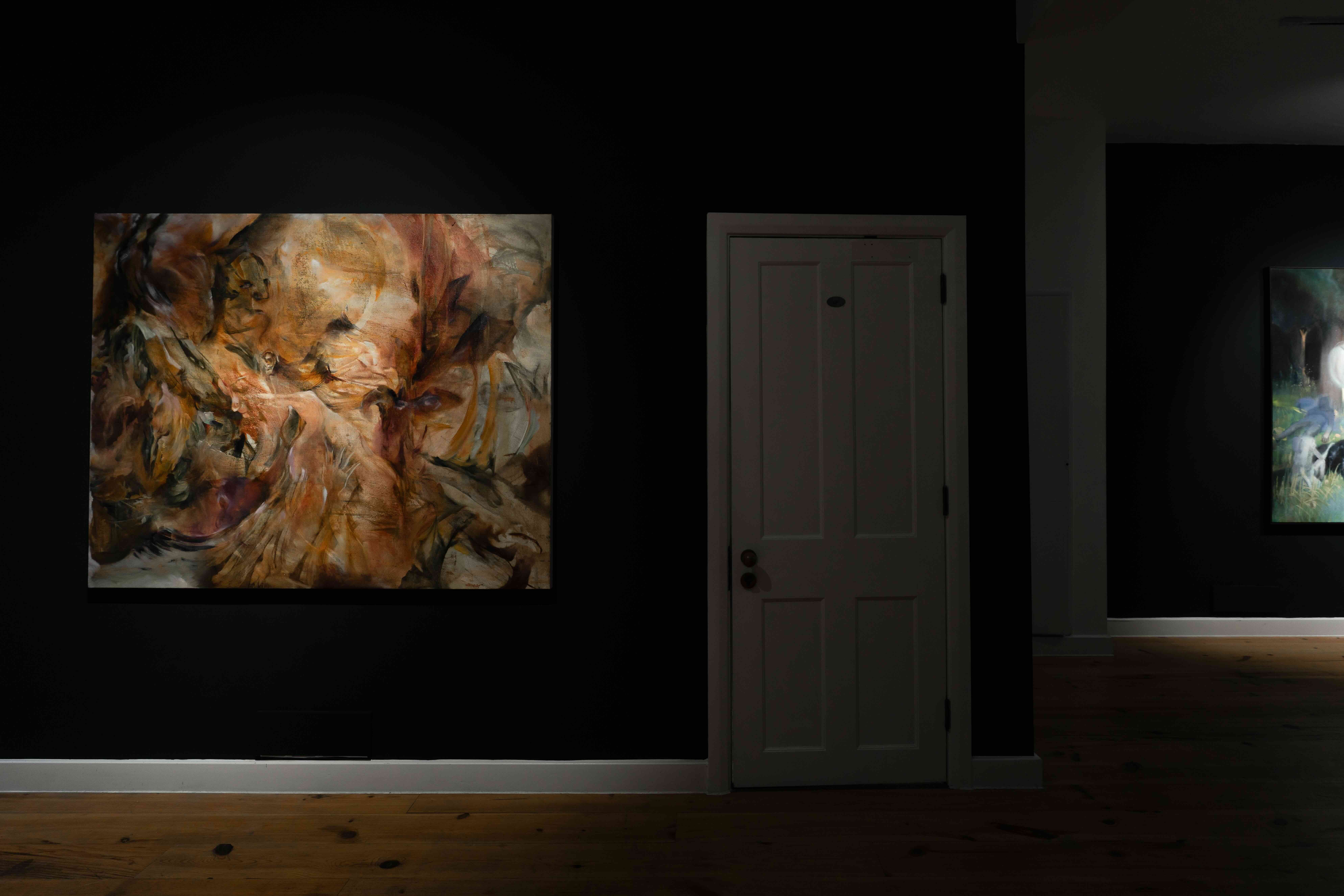
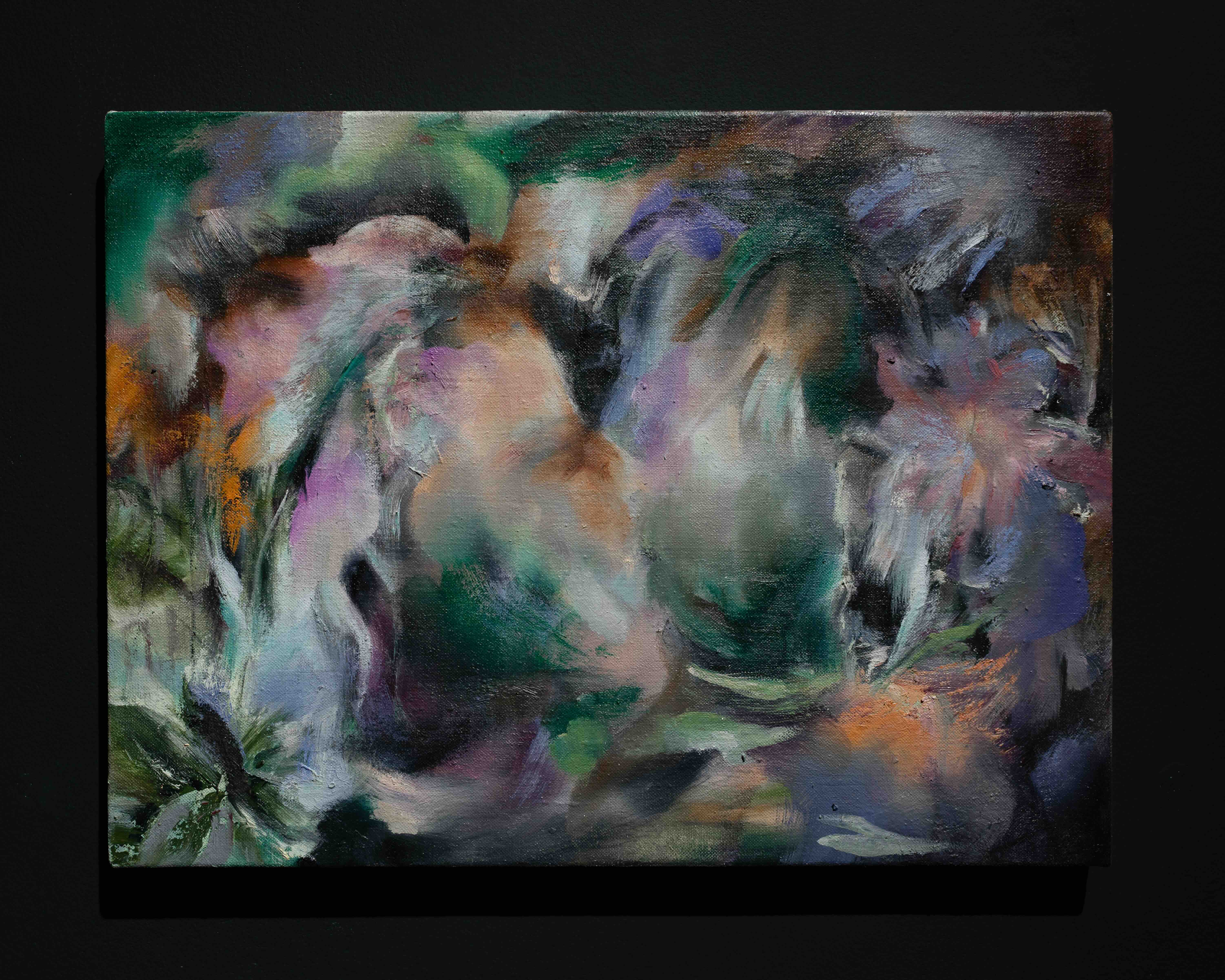
This approach finds its full, immersive expression in her large-scale paintings, One Thousand Sunday Suns and The Winged World (2025). These works inhabit a terrain of perpetual metamorphosis, where bodies, landscapes and atmospheres bleed into one another without settling into fixed form. In One Thousand Sunday Suns, warm earth tones churn into vegetal, smoky textures, producing a vortex of gestures in which faces, limbs and organic matter flicker in and out of recognition. The Winged World extends this logic into a more tempestuous register, its bruised greens and purples gathering into a storm of wings, clouds and half-submerged figures. In both, the paint behaves like a living substance – muscular, volatile and porous – creating scenes that feel weathered into existence. In contrast, a smaller painting like Hidden Hold (2025) compresses this atmospheric turbulence into an intimate, almost inhaled scale. Here, the image feels like the interior of a gesture – a pocket of movement briefly stilled. Soft violets, greens and smoky blues mingle with flashes of peach and ochre, creating a chromatic mist that refuses to settle into recognisable forms. The brushstrokes appear to brace around a secret centre, containing a latent energy that is never released – a vessel of suspended potential.
In Spectral Message, the artists create a coherent visual conversation from opposing approaches. Ahn presents memory's imagery – seemingly concrete pictures that remain elusive despite their detailed staging. Stephenson manifests memory's sensation – the texture of recall, the erosion of detail, the physical weight of the past. Where Ahn’s work suggests dreams whose clarity dissolves upon examination, Stephenson’s embodies the lingering atmosphere that remains. Both artists use this ambiguity to examine interior worlds beyond visible reality, creating spaces where viewers must project their own narratives onto the shifting forms. Their contrasting methods – orchestration versus excavation – unite here through shared luminous palettes of blues and lilacs, and through figures that exist between presence and absence.
This exhibition represents a collaborative presentation by Studio West and NORITO, organisations united in supporting early-career artists. Studio West, founded by Caroline Boseley, functions as a residency providing practical mentorship and studio spaces, enabling artists to develop sustained practices outside rapid exhibition cycles. NORITO derives its name from the Korean word for play-ground (testing, performing, rehearsing-anchoring), representing a space of encounter, alongside the Japanese norito (祝詞), Shinto incantations joining speech to ritual. Founded by recent RCA Curating graduates Soyeon Jung and Pon Chanarat, NORITO emphasises collaborative, curatorially rigorous exhibitions. This partnership mirrors the relationship between Soryun Ahn and Lulu Stephenson, RCA painting contemporaries now exhibiting together for the first time. Their parallel trajectories demonstrate how supportive frameworks enable distinct artistic voices to develop and converge. Together, they propose that meaning resides not in resolution but in continuous interpretation – a spectral message perpetually taking shape in the viewer's engagement.
Text by Sophie Barhsall
Selected Works
Lulu Stephenson
Hidden Hold, 2025
Oil on linen
130 x 170 cm
Lulu Stephenson
One Thousand Sunday Suns, 2025
Oil on linen
130 x 170 cm
Lulu Stephenson
The Winged World, 2025
Oil on linen
130 x 220 cm
Soryun Ahn
Between the Dawns I, 2025,
Oil on linen
60 x 70 cm
Soryun Ahn
Between the Dawns III, 2025
Oil on linen
60 x 70 cm
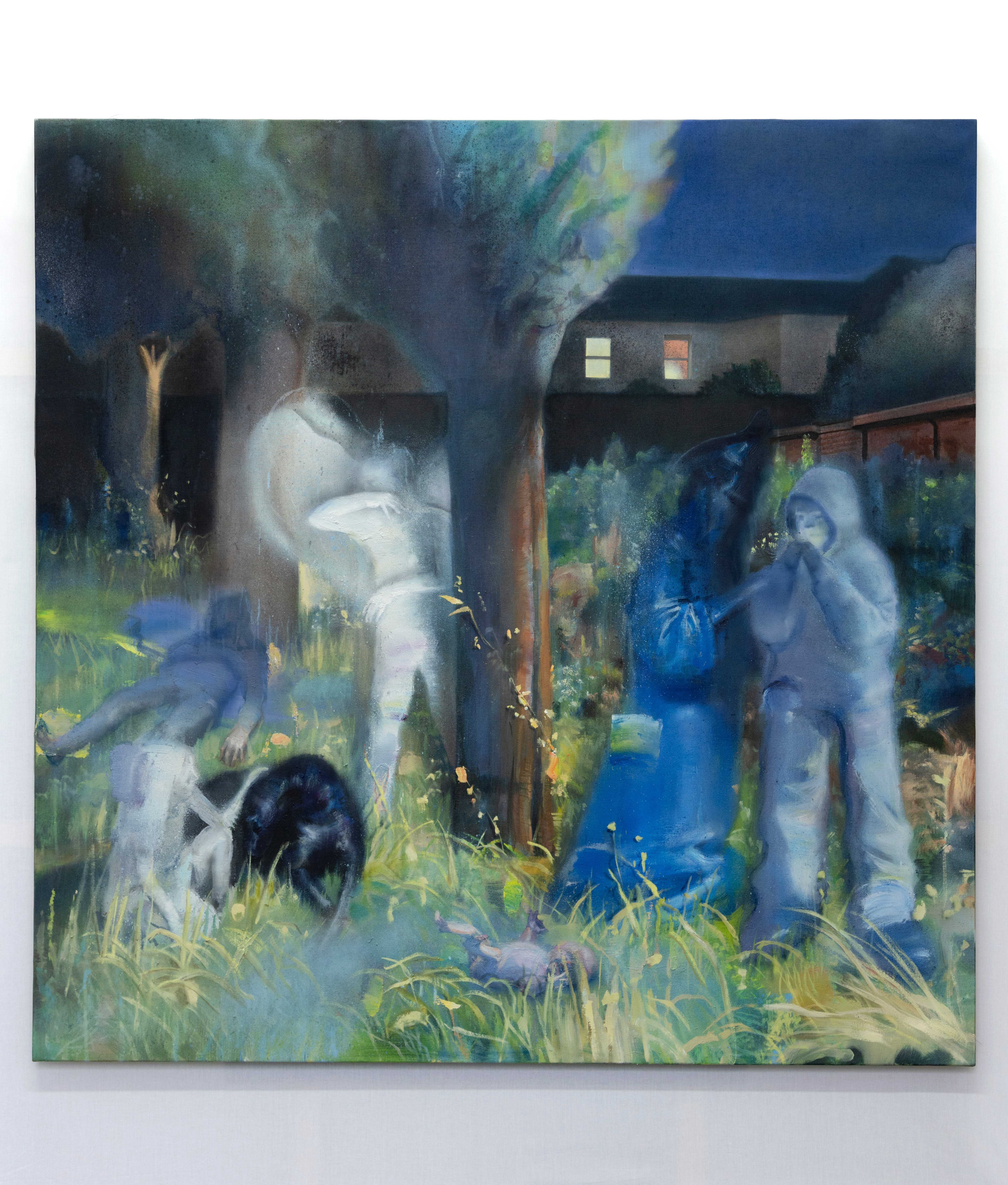
Soryun Ahn
Nocturnal Apparition, 2025
Oil and lacquer spray on linen 150 x 150 cm